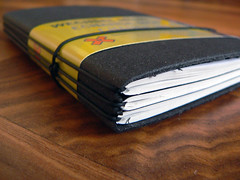
Well, perhaps you should consider an elastic-bound notebook.
I recently came across not one but three different manufacturers of an interesting style of notebook that may just be right for you if you want more flexibility than, say, a Moleskine, but you don't want to be encumbered by metal ring mechanisms.
As shown in the image above (of an X17 notebook), this type of notebook lets one bundle together a number of thinner books, each for whatever purpose you wish. Since, for instance, your journal booklet is not the same as your agenda booklet, it's easy to swap out a full journal for a new blank one and yet keep your agenda as is.
- X17 is a German company. It's offers a number of cover styles and types for inner booklets supporting various styles of agendas, organizers, and notebooks. Each booklet is simply slid under one of several elastics that wrap around the spine. The elastics hold the booklets in place. Notches at the top and bottom of the spine keep the elastics properly aligned. Another elastic, tied at the spine, wraps around the cover to hold it closed. There may be a risk that the elastics on the outside of the spine might catch on other objects.
- X47 is the luxury model of the X17. These have a system of metal hooks to hold the booklets in place and seem to be made of high quality leather. They're quite pricey.
- Whitebook is a Swiss company selling handmade leather-covered elastic bound agendas, organizers, and notebooks. They use elastics, like the X17s, but the elastics are attached inside the leather cover; not being exposed, they shouldn't catch on anything. Whitebooks can also house various types of tablet computers. These too are quite pricey.
They all come in a variety of sizes.
I haven't tried any of them, but I'm thinking of trying a small X17.
If anyone has tried these notebooks, or have any thoughts on them, feel free to leave a comment.
