Tuesday, February 11, 2014

A distinctive type of paper notebook

So many manufacturers of paper notebooks just really make books.  The paper will vary, the type of lines will vary, the covers will vary - some give you perks like pre-numbered pages.... But they're still just books.  Books are all or nothing. You write in them till they're finished and there's absolutely no chance of "rearranging" pages.  You could use a ring binder (like a Filofax) but you don't like rings.  What do you do?

Well, perhaps you should consider an elastic-bound notebook.
I recently came across not one but three different manufacturers of an interesting style of notebook that may just be right for you if you want more flexibility than, say, a Moleskine, but you don't want to be encumbered by metal ring mechanisms.

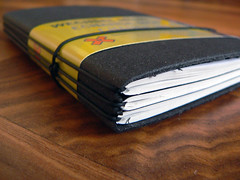
As shown in the image above (of an X17 notebook), this type of notebook lets one bundle together a number of thinner books, each for whatever purpose you wish.  Since, for instance, your journal booklet is not the same as your agenda booklet, it's easy to swap out a full journal for a new blank one and yet keep your agenda as is.
  • X17 is a German company.  It's offers a number of cover styles and types for inner booklets supporting various styles of agendas, organizers, and notebooks.  Each booklet is simply slid under one of several elastics that wrap around the spine.  The elastics hold the booklets in place.  Notches at the top and bottom of the spine keep the elastics properly aligned. Another elastic, tied at the spine, wraps around the cover to hold it closed.  There may be a risk that the elastics on the outside of the spine might catch on other objects.
  • X47 is the luxury model of the X17.  These have a system of metal hooks to hold the booklets in place and seem to be made of high quality leather.  They're quite pricey.
  • Whitebook is a Swiss company selling handmade leather-covered elastic bound agendas, organizers, and notebooks.  They use elastics, like the X17s, but the elastics are attached inside the leather cover; not being exposed, they shouldn't catch on anything.  Whitebooks can also house various types of tablet computers.  These too are quite pricey.
They all come in a variety of sizes.

I haven't tried any of them, but I'm thinking of trying a small X17.

If anyone has tried these notebooks, or have any thoughts on them, feel free to leave a comment.

Sunday, February 2, 2014

Paper beats laptop for learning

Here's an interesting bit of research: psychologists have found evidence that taking notes on paper improves learning and retention compared to taking notes on laptops.


The results of the experiments that led the researchers to this conclusion are soon to be published, but the tl;dr version is this: regardless of whether it's short term learning or long term retention (for, say, final exams), and even regardless of whether the students were told about the effect and how to counteract it, students who took notes by computer generally performed worse than those who took notes on paper.

According to the research, the difference between paper and laptop is that note-taking on paper requires a greater degree of cognitive engagement. You have to make an effort to take notes on paper, think through what you want to write, how to write it, and how to annotate it for later study - an effort that is not required when using a computer.

While I would expect this research needs to be validated by other, future experiments, I see this as supporting something most teachers already know from experience: you can't learn if you don't really invest in the whole process - there are no shortcuts.

Thursday, January 30, 2014

Toodledo trick: rolling tasks

Toodledo can sort your tasks in multiple, customizable ways.  I've found a neat "trick" that let's me generate a rolling list of tasks based on sorting tasks by their modification date.
I have a bunch of tasks that:
  1. are undated, and
  2. are not especially urgent, but should be done sooner than later, and
  3. may not be possibly completed in one sitting.
These are tasks that I want to poke at fairly regularly, but that are less important than other (say, dated) tasks.  The problem is finding a way to automagically rearrange them (so I have less meta-level task management to do) and still help ensure I don't neglect any of them for too long.

Toodledo can sort a task list in multiple ways.  One way is by modification date; if any field in a task is changed, the modification date is updated.  Whenever I work on one of those "better sooner than later" tasks, I update the Note field with a short status update.  This resets the modification date of the task (and also leaves me a hint of how far I'd gotten for the next time I work on the task).

Then I sort those tasks by reverse modification date.  This puts the task I most recently worked on at the end of the list.  More importantly, the tasks at the top of the list are the ones I haven't worked on for the longest time - which are the tasks I really should work on again as soon as I can.

So now, once I've gotten everything else out of the way (e.g. tasks due today, urgent/unavoidable things, etc), I work on one of the first tasks in that "better sooner than later" list.  If I complete it, I check it off and it's gone forever.  If I don't finish it, I update the Note field to remind myself for next time how far I'd gotten and refresh the list.  That item will move to the end of the list.

If you're a fan of autofocus-style productivity systems, this trick pretty much lets you implement autofocus in Toodledo.  If you're like me, and want more structure in your system without going full-GTD, then you can add whatever structural elements you like from Toodledo and still have that rolling list available.

Personally, I sort my Toodledo Hotlist using all three sorting parameters (Toodledo lets you choose up to three nested types of sorting).  My first sort is by Toodledo's "Importance" measure, which is a neat single metric that includes due date, priority, etc.  The second level sorts tasks that all have the same Importance as calculated by Toodledo; that's where I reverse-sort by modification date.  The third sort will sort tasks that have both the same Importance and the same modification date. My third sort is by priority.

Do you sort your Toodledo tasks differently?  If you do, leave a comment and share your insights.

Sunday, December 29, 2013

I'm calling bullshit on this technique to "beat procrastination"

Lifehack.org is a productivity website.  It's supposed to help people get their lives in order and live more happily.  Unfortunately, it - and  virtually every other productivity website I know of - has pretty low "quality assurance."  That is, some material available at Lifehack is good, some of it is rather terrible, and there's precious little way to tell the difference.

Case in point: It's no good getting furious if you get stuck, by Ally Leung.  It's hook is entirely unrelated to the meat of the piece, and the meat itself is pretty rancid.


The piece starts with a quote by Stephen Hawking about knowing when to pause a task on which you're not making progress.  Leung then magically equates the word "stuck" in the Hawking quote with procrastination, the bubonic plague of productivity wonks - or, as Laura Leigh Clarke calls it, "the silent killer of dreams."

1. The word "stuck" can be associated with procrastination, but needn't be always.  If you ponder Hawking's quote for more than a few seconds, you'll realize he's not at all talking about procrastination.

Who is Laura Leigh Clarke, you ask?  That's the author of the piece that contains the (alleged) answer to the question of procrastination posed by Leung, a piece linked at the bottom of Leung's own piece.

2. Lifehack gets you to visit two of their pages for the price of one promise of useful information.  This is a pretty blatant attempt to superficially "drive web traffic" without offering anything substantive in return.

Clarke's piece is summarized by this one paragraph: "The point is, there are some things we each love to do, that are within our natural flow, and there are things that make us feel stuck. The key to getting back into flow and overcoming the stuck-ness is simply a case of spending a greater proportion of your day on tasks that are within your flow. The degree to which you can do this, is the degree to which you will THRIVE."

Another way of saying this is: do what you want, not what you have to do.

And that is just plain wrong.  We don't live in a Star Trek universe where everyone can do whatever they want.  To get to do what you want, you will have to do things that you don't want to do.  Want to play guitar well?  Well, you'll have to practice, and practice, and practice till your fingers bleed.  Wanna be a heart surgeon?  You'll have to do go through years and years of training doing things that you'll think are stupid and absurd.

And even if you can get to do what you really want to do, there will be collateral indignities waiting for you at every turn.  I love to teach, but the administrivia surrounding it very nearly suck the fun and value out of it entirely.  I love being able to read the paper in bed with my wife, but to do that means working hard on things I don't really believe in - not because I've chosen to do those ugly things, but because they are quite literally inevitable.

See, that's not what the Hawking quote was on about at all.

Hawking encapsulated two important ideas in that quote.

First, actively trying to solve a problem isn't the only way to do it.  There is significant scientific literature indicating that once a problem is firmly nested in your wetware, it will keep running even if you're not consciously thinking about it.  Keith Sawyer, for instance, has demonstrated quite clearly (in my opinion, at least) that those magical, so-called "moments of inspiration" that we all have from time to time are really just the unconscious part of your mind sending a solution to the conscious part of your mind.  You think it's a revelatory moment only because you weren't conscious of all the work your brain was doing.

It is important, however, to study the problem very intensely before setting it aside from your consciousness.  In all documented cases of this sort of revelatory cognition having happened, it was preceded by intense study.

Second, Hawking recognizes that nothing is so important that it is worth one's active attention, to the exclusion of all else, for a protracted length of time.  Just because he set aside the question of information loss and black holes for 29 years does not mean he just sat around with his thumb up his ass.  He got all kinds of other incredible work done.

3. This relates in no way whatsoever to procrastination.

The question isn't even really about procrastination, it's about getting everything done and not just the stuff you want to do.

I've got my own way of doing that, but I haven't the time right now to write it up.  Once I do, I'll post it here.
Sunday, August 18, 2013

Journaling is good for you

Here's a post at BBC (16 August 2013) advising us that journaling is good for our health, but warns against "online" journaling.

Well, Duh!

I've long advised my students to get their ideas out of their heads and onto paper.  And not just to scratch out a few words intended to jar one's memory later, but really take the time to write out as precisely as possible what the idea is, and to come back often to revisit and revise it.

There's a good reason for this: once a thought has been externalized, it is in a way part of the objective world of reality rather than only part of the subjective world of our minds.  Entirely subjective things are notoriously difficult to analyze, learn from, improve, etc.  But if you've got it lying there in front of you, detached from whatever happens to be going on in your mind at that moment, then you can bring to bear the full arsenal of your brain's analytic capabilities.

The BBC article basically says that we can do that with our own emotions too.  When we journal about what happened to us and how we feel about it, we are preserving (albeit not particularly well, of course) our psychological and emotional state at the time.  There are two benefits, one immediate and one long-term.

The immediate benefit is that the act of expressing something seems intimately connected to understanding it.  Finding the right words to properly represent our emotions goes a long way to explaining to our own brains what we're actually thinking and feeling.  And your brain can use that to better and more fully integrate the described experience into your psyche.

In the longer term, you can learn a lot about yourself by re-reading your journal and reading what you thought about long-ago, barely-remembered experiences.  Of course, this benefit requires more discipline than many people have these days - you have to be diligent both about carefully documenting your life and making the time to go back and re-read attentively.

There's one proviso here: there is, as far as I can tell, both no benefit and many dangers to journaling "socially" - via the dreaded Facebook or some such.  As the fictional-but-nevertheless-wise Gregory House said: "Everybody lies."  And you lie to yourself too.  However, it is far more difficult to be honest to others than it is to yourself.  You ought to journal for your benefit alone, and not to seek advice or to titillate others, or to gain social standing.  You journal to understand yourself; that requires honesty; and honesty comes easiest in privacy.

There is also a danger - one that I think has been blown out of proportion, but that truly exists nonetheless - that if you "share" your journal, you will open yourself up to unnecessary and generally harmful criticism by people who don't really know anything about.

Obviously, this does not mean you can't use journaling software; of course you can.  I tend to use Evernote for that (but I also sometimes use pen and paper).  It's not about the tools you use, it's about the audience.  The proper audience for your personal journal is only you.

So, get in there and write!

Thursday, August 15, 2013

Updates on the companion site: tips & tricks

I have unfortunately neglected the companion website to this blog, for reasons not pertinent here. However, I have started to update that site and wanted to let you know.

There's all kinds of lists out there on the Web on how to be productive, creative, innovative,....  I noticed that many of them have very significant overlap.  That, for me, is a design problem: Why are there so many lists?  Why hasn't anyone yet thought to integrate all these lists together into a "best hits" list?


I've found that some items on some lists are better than others on other lists, but that the biggest problem is that there no "encyclopaedic" resource trying to stitch them all together into one authoritative reference on tips and tricks.

Well, I don't know why this is, but I'm started to address this perceived shortcoming by starting a list of my own.

Actually, I expect there to be a couple of lists, because I think there's at least a couple of areas covered by the lists I've seen that don't overlap much.  Being productive, for instance, isn't the same as being creative.

At the moment, there's just one list, and it integrates only two sources (fully referenced, of course) on innovation/creativity.  But that's just because the first two links I yanked from my "list of useful links I haven't got time to deal with yet" were both on innovation.

I must have over 50 such links hiding in "storage," and I keep finding more all the time.  So these lists will grow and become more refined with time.

The first list is on Being Innovative, and you can find it at: https://sites.google.com/site/dofastandwell/project-definition/spreading-ideas.

Saturday, June 29, 2013

Ring-binding wins my heart

I think it's official: after years of vacillation and procrastination, I've finally committed to ring-bound notebooks as my preferred way to stay organized.


I have for years now irregularly switched back and forth between ring-bound notebooks (mostly those of Filofax and Succes) and hard-bound notebooks (mostly Circa, Moleskine, and Leuchtturm1917), never quite being able to decide once and for all which best suits my needs.

Most recently, I forced myself to use, for the better part of a year, hard-bound books both for the small, in-my-pocket, just-in-case kind of book as well as the larger, take-to-meeting and think-deep-thoughts kind of book.  (In case you want to know, I was using a pocket sized Leuchtturm1917 softcover, and an A5-ish Legami - kind of an Italian Moleskine knock-off).  By doing this, I was able to quite crisply decide what the most important and unavoidable requirements are, for me, in a good book.

This is what I've come up with:

  1. I want to be able to reorganize the pages.  That is, I like to group pages by topic.  Personally, I find it easier to search for information later.  This gets rid of the need to "tag" pages, and track continuation pages, etc.
  2. I keep both temporary notes - which will quickly become useless - and long term, journal-like notes.  That means that some pages will be full of crap, and others of useful stuff.  A hard-bound book mixes those two up.  Pages for scratch notes are "wasted" in that I can't use them for more significant stuff.  In a ring-bound book, on the other hand, I can just replace spent scratch note pages with fresh new pages as needed.
These are my two single more important requirements.  Everything else is just icing on the cake if not total fluff.  Once I realized that, I also realized I really had no choice but to use ring-bound books.

And while I regret having to give up the... pleasure of using a hard-bound book (a pleasure, I note, that I cannot explain at all except to say that I get a sense of importance or significance form a hard-bound book that I find lacking in ring-bound books), I have always been compelled by evidence. And the evidence tells me that without question, ring-bound books are right for me.

So now I use a very slender Omega binder (I bought it "vintage" on eBay, and I cannot find others like it).  Its rings are small (about 13mm) and its just large enough to accommodate Senior sized Succes sheets.  I'll be replacing the larger Legami hard-bound book with an A5-sized binder that I also got from eBay and appears to be from China.  I'll blog about that one later.

For now I'll leave you with this boring image of my new Omega binder.